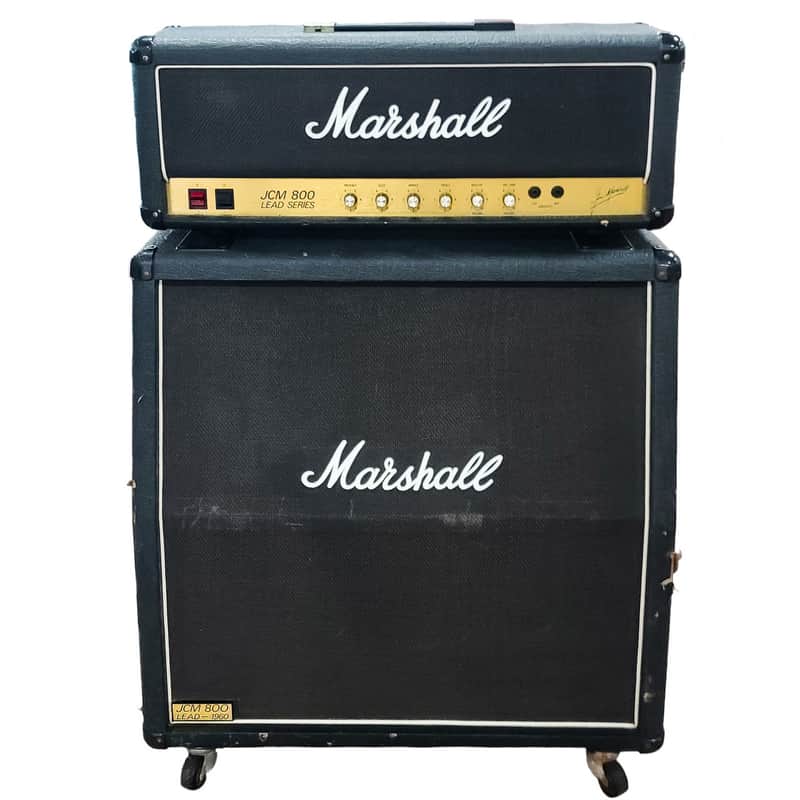
Many amp enthusiasts often differentiate two main types of classic tube amplifers: American and British. This of course is code for Fender and Marshall. Of course there is also Supro, Dearmond, and Magnatone also on the American side. Vox, Orange, Hiwatt, etc on the British side. So what characterizes their differences? I tend to think of it in terms of two separate ideas; tone and gain.
The story I read is that burgeoning rock and rollers demanding electric guitar amplifiers in the UK, inspired Jim Marshall to create his first amplifer based almost entirely on the Fender Bassman amp of 1959. It would have probably been an exact copy of Fender’s Bassman, except for the fact that he couldn’t readily get the proper tubes in London, so he used approximate ones and compensated other components to accommodate them.
These changes created a different sound than the original and began the British sound. I think of marshall amps as having more mid range emphasis than Fender amps which have less midrange emphasis, what people call “scooped mids”. This is likely to the British style tubes used EL34, EL84 power tubes.
Another story I read is that Pete Townsend, or Eric Clapton, or both emplored Jim Marshall to make their amplifiers louder and louder to meet the demands of larger venues without PA systems. (Often the PA systems would simply amplify the vocals.) These efforts began to change the overall wattage, but also the gain stages. Typically a simple amplifer has two gain stages; preamp gain, and power amp gain. Jim Marshall experimenting with increasing gain levels at the preamp stage began to create the tube-saturated, over-driven, high-gain, compressed, midrage sound we all now associate with the Marshall sound. And rock and roll loved it!
Fender amplifiers continued to be the best at clean beautiful guitar sound. In the 70s they did create modified versions of their most popular amps that featured a master volume and other methods to add more gain to the preamp stage. Likely a response to Marshall and Vox amps. These didn’t really last long as perhaps the inherent scooped mids didn’t work as well at overdrive sounds and often had flabby bass etc. Marshall went on to experiment further with more preamp gain stages creating in the 80s the High Gain Marshall sound.
There are some exceptions. I have a reissue of the 1957 Deluxe amp known also known as the 5E3 circuit, and this has an amazing overdrive sound, but it is still quite different sound than the Marshall sound.
What also happened is that with some guitarist, pedals began to become the preferred way to create preamp gain stages, and clean Fender amps began to be viewed as being more versatile than Marshall amps.